TRADITIONAL CEREMONIES IN JAPAN
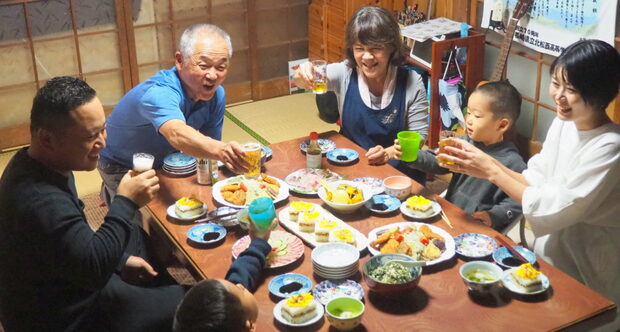
 Most traditional ceremonies in Japan originated in China. Some have disappeared. However, even today, almost every Japanese family still holds various traditional ceremonies.
First, in January, there is the Shogatsu (New Year) ceremony. The entrances of houses are decorated with pine branches and a type of sacred rope. In the morning, mochi cakes are eaten. Many people go to pray at Buddhist temples and Shinto shrines.
At the beginning of February, there is Setsubun (a ceremony held the day before the start of autumn according to the lunar calendar). This signifies the end of the long winter. On the evening of Setsubun, people scatter beans, hoping that with the beans they can ward off evil spirits and invite the gods of good fortune into their homes.
On March 3rd, there is Hina-matsuri, a girls' festival. Girls decorate their homes with Hina-Ningyo (girls' festival dolls). May 5th is the Boys' Festival, where boys raise Koinobori (flags shaped like fish with long tails).
In July, there is Tanabata, the Star Festival. Only at night once a year does the Ushikai Star cross the Ama no Gawa and then meet the Orihime Star. This is a Chinese romantic story.
In the Kanto region, in July and in the Kansai region, in August, "Bon Ceremonies" are held. During the Bon Ceremonies, our ancestors return to earth. We welcome them on the first day and send them off on the last day by lighting fires for their journey home. The famous Daimonfi in Kyoto is one such ceremony.
In autumn, the skies are clear and the moon is beautiful. We enjoy the full moon in September. October is a good month for sports. Schools hold athletic competitions. Many people also enjoy mountain climbing and cycling.
Autumn is also the harvest season. Many villages and towns hold ceremonies to celebrate the bountiful harvest in October and November.
November 15th is the Shichi-go-san ceremony, a children's ceremony where parents take their three-, five-, and seven-year-old children to worship at shrines.
Everyone is very busy at the end of the year, cleaning their homes and making mochi (rice cakes). On New Year's Eve, at midnight, the temple bells ring to signal the passing of the old year and the arrival of the new.
Data source: ATARASHI NIHONGO
Editor: Yoshida Yasuo